A terrifically tasty, historically fascinating, Hungarian pastry
It’s been nearly 15 years now since we first started making Rigó Jancsi (pronounced ree-GO yan-CHEE) at the Bakehouse. To this day, it remains one of the most elegant and excellent pieces of pastry we make. And the story behind it is just as good as the pastry. Reflecting on it in the context of what I wrote about up top, it’s the product of a range of different influences coming together and begetting an exceptional creative outcome: ancient Roma culture in Europe with roots going back to India; new 19th-century American wealth created here in the Great Lakes region; the 19th-century phenomenon of Roma musicians professionalizing traditional Hungarian tunes previously played really only informally in remote rural communities; prestigious Parisian café culture, and the Austro-Hungarian predilection for fancy pastry. There’s a bit of each and then some in every single slice of this super tasty torte.
Before there was a pastry, there was a person—back in the day, Rigó Jancsi was a headline-grabbing Roma violinist in Europe in the late 19th century. If I were writing this newsletter in 1896, I might well have listed his music in the “Listening” notes I add in at the end of each week’s edition. That was the year in which Jancsi fell in love with Clara Ward, an American woman who left her Belgian-prince husband to run away with him. In an era before cinema, Ward was, herself, quite the glamorous celebrity at the time: Toulouse-Lautrec painted her, Marcel Proust pursued her, and she later became a character in Cole Porter’s musical Can-Can. Postcards with her picture were as popular as any modern-day baseball player. In the context of negative beliefs and bias, the fact that the Roma people were and still are one of the most persecuted groups in Europe, the degree of drama was increased because it was a Roma man running away with a woman from a royal family. When Jancsi died in 1927, at the age of 60, The New York Times quoted him in his obituary, saying,
All my world was in my violin until I saw her. She was the most beautiful woman in all Europe. Kings loved her. The night I saw her first she turned from King Leopold to smile at me. Ten days later, like two gypsies, we stole from her palace in the dead of night, and I took her to my mother’s hut in the mountains near Pakozd, where I was born. Then we went to Yokohama, where an artist tattooed my picture on the arm of my Princess. And here is her picture on my arm. To my grave I will carry it—next to my heart.
Per the wisdom I learned from the former head of Southern Studies at Ole Miss, Ted Ownby, there are any number of different and gently disputed origin stories for the cake we make now at the Bakehouse. The best business-focused version is that it was developed by a creative Budapest baker to take advantage of the headlines. A more romantic story is that Rigó Jancsi baked it for Ward himself, and served her the first slice, saying, “Try it! It’s brown like my skin, and sweet like your heart!”
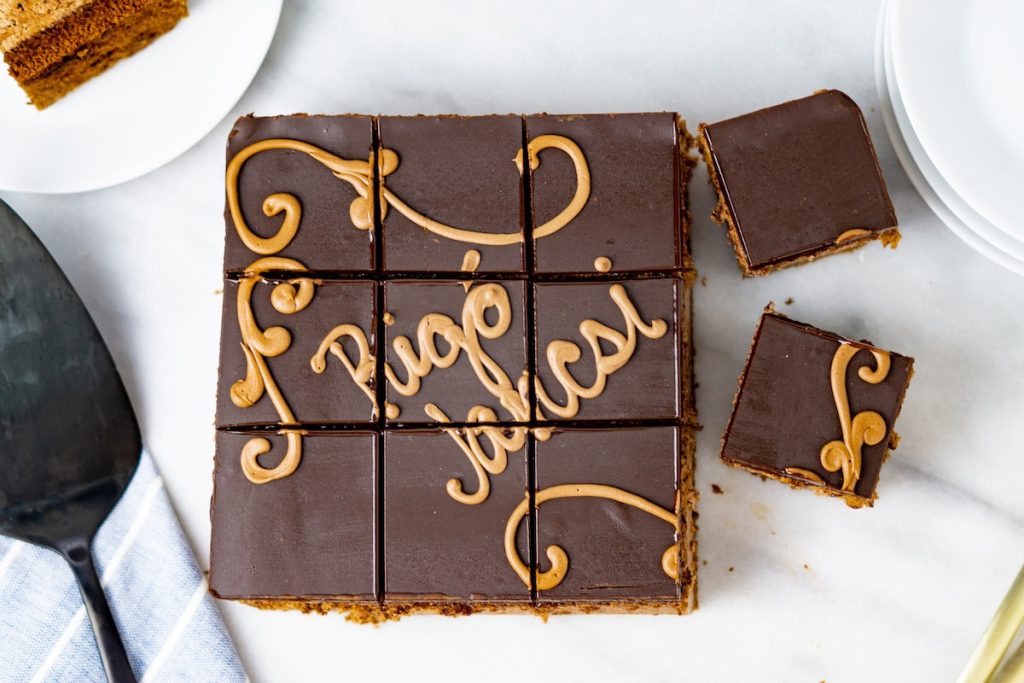
Today, it is still both brown and sweet, and this beautiful torte has the name Rigó Jancsi scrolled in script across the top. It’s composed of two light layers of chocolate sponge cake filled with chocolate rum whipped cream and iced with apricot glaze and dark chocolate ganache. The rum is meaningfully present but remains, supportively, in the background. The cake has a great, complex flavor and a lovely finish. When the famous couple split in 1905, Rigó Jancsi moved to New York, where he played regularly in any number of high-end restaurants. The cake, as you can tell, continues to be made over a hundred years later.
You can pick up a whole Rigó Jancsi or grab a slice at our Next Door Café. Pro tip – it’s terrific with an espresso!