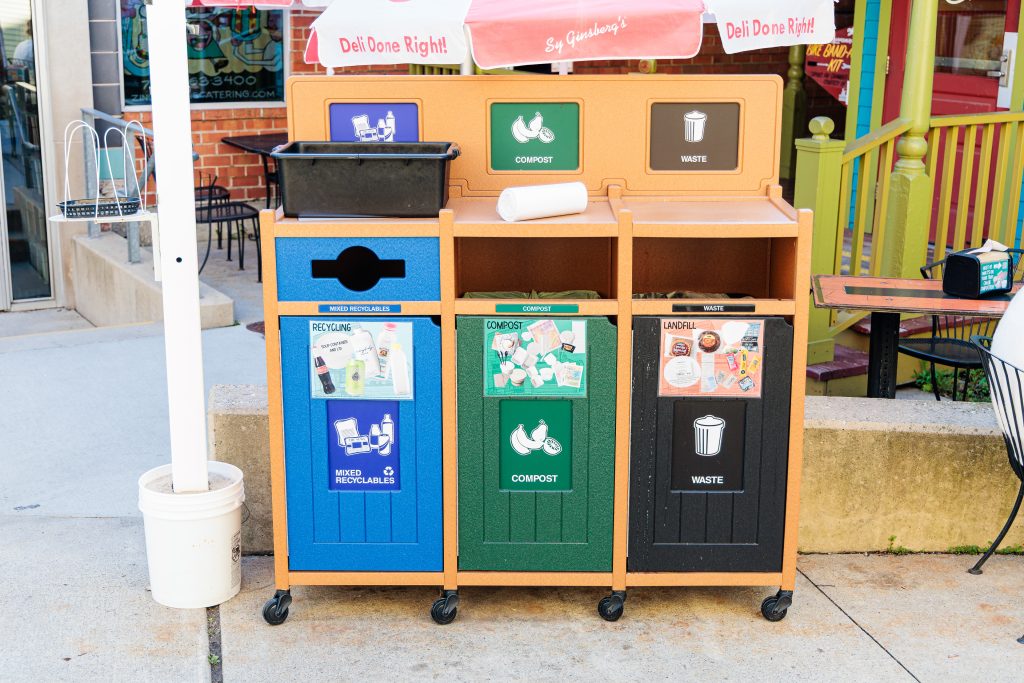
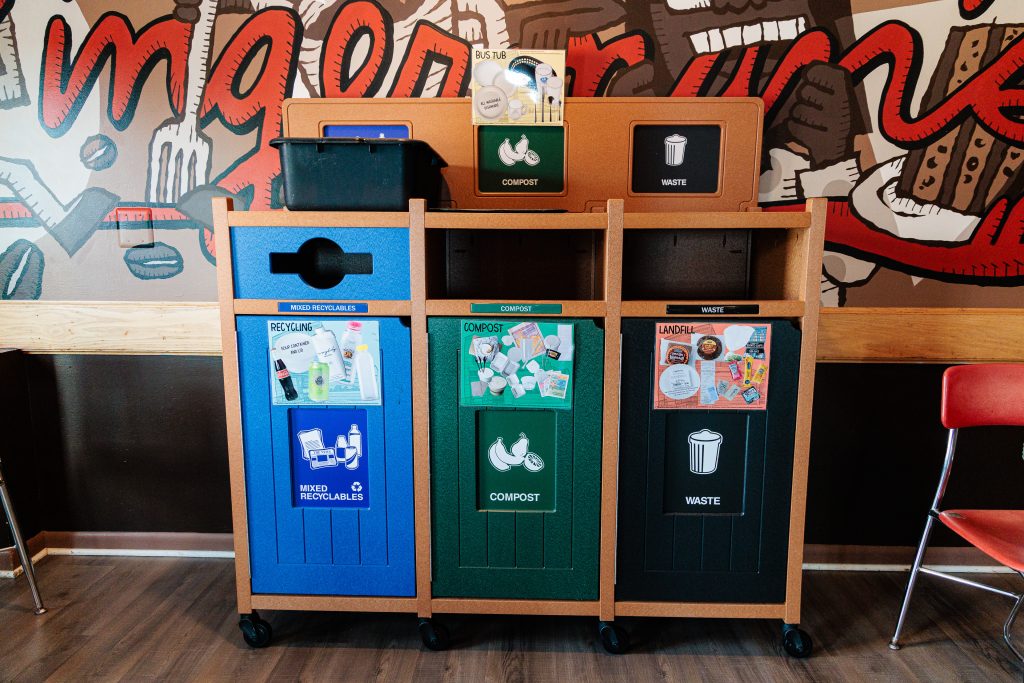
We’ve made a pretty exciting switch here at the Delicatessen recently: we’ve replaced all of the standard trash cans in our dining areas with three-compartment bins for recycling, composting, and trash! We know, we know, this might not sound as exciting as, say, a new special sandwich on the menu, but we promise it is. Join us as we dive into how we handle our waste streams.
Digging into the Work That Has Led Up to This
If you have a sense that this might be a big change to make, you’re absolutely right—it is. At the same time, efforts like this one are just part of who we are. Our work is guided by documented principles to be mindful of our environmental impact and to take proactive steps to improve. In our Statement of Beliefs, we say, “We believe business is a way to do good in the world … We leave everyone and everything we interact with better than when we first came into contact—staff, customers, the community, vendors, and the environment.”
We follow through on that in a variety of ways. We’re members of multiple business sustainability efforts (the Sustainable Food Business Coalition, Great Lakes Business Network, 2030 District, and Green Business Challenge). We’ve supported the City of Ann Arbor and Washtenaw County’s goal of moving toward zero waste for many years. We’ve also supported the county’s Solid Waste Management Plan, specifically promoting the increased diversion of commercial recycling and composting that our own efforts are in line with. We’ve done our part to increase total city and county diversion rates by making purchasing decisions that are considerate of our waste stream; eliminating single-use plastic water bottles in favor of local water cartons is just one example.
We’ve established robust compost collection practices in our back of house and pioneered a returnable takeout container program to reduce our dependence on disposable products. We train our staff on proper recycling and composting and work tirelessly to reduce as much waste as possible across our business. So, after years of work mostly behind the scenes, we were ready to focus our attention on our guest areas.
Thanks to the grant we’ve received from Washtenaw County’s Waste Reduction Sponsorship, we’ve been able to make that happen! The funding helped us procure the proper collection receptacles for all of our dining areas and train our staff on this new aspect of our operations.
Adding functional and attractive collection receptacles around our campus is a major expense (as is the increased cost of compost collection), so we are very grateful to the county for its support.
The Dirt on Our Latest Change
Of course, our concerted effort to increase the number of our products that can be composted is only effective if we can also make sure they actually do get composted. That’s where the new three-bin system comes in. Because while we were already composting in our kitchen and back-of-house areas, it’s important that you’re able to help us compost, too.
Know Where to Throw
At the risk of sounding obvious, the goal of a better waste stream is for fewer items to go into the trash and for more things to be composted and recycled. The good news is that almost all of the items you receive in your order can go in the recyclable or compostable bins (or in bus tubs on top for us to wash and reuse—maybe we should have called it a four-bin system …?). Which means the trash section should indeed fill up the least! We also recognize that the change might be tricky. Many of our compostable items look like they are recyclable, and if not properly sorted, they create contamination and defeat all of the hard work we have put into this process. How do we avoid that and maintain squeaky-clean waste streams?
Training and education! They’re already fundamental to our business; we actually start on day one—including an introduction to our sustainability goals. Having a big focus on training helps ensure little to no contamination in our compost collection, and it also meets the comprehensive education goals of the county’s program to achieve the goals of the waste plan. Additionally, training helps our staff share information about our sustainability work and the county’s commitment to zero waste and 100% diversion as easily as we can chat about the ingredients on a Reuben. Education extends to you, our guests, too—we’re trying to make helping Mother Earth as straightforward as possible. We’ve added sorting signage on our bins and created a page on our website dedicated to waste collection. We even made an interactive waste-sorting training game for our staff and are currently looking for options to make it available to our guests! Which is all to say: we’re ready for the challenge. Should you have any questions, we’re happy to help!
We’re Soil-mates with Mother Earth
Keeping our waste stream free of compostable and recyclable materials helps support a circular economy; only the items that are truly trash end up in a landfill, while everything else gets a new chance at use. And while adding some three-compartment bins might seem like a fairly small change, we believe it will make a BIG impact. We estimate that we’ll increase compost diversion by 50% annually—from over 450 to nearly 700 tons! We also expect that our new bins’ consistent look and clear signage will increase the overall amount of recyclable materials we collect in our dining areas. And, since half a million of you visit us every year, that’s a lot of people seeing our community’s commitment to sustainability firsthand, as well as what might be possible in other restaurants.
*Eagle-eyed Environmentalists: Did you catch that PLA materials get sorted into the organic collection? We think they’re preferable to plastics for many of the “disposable” products we use, and while they aren’t an accepted item for your Ann Arbor curbside city compost collection, they are allowed by our compost hauler, My Green Michigan.