
Archive for March, 2010

The Historical Twists and Turns of Traditional Pasta

Monday, March 22nd, 2010 by Zingerman's Deli


“Everything you see, I owe to spaghetti.” —Sophia Loren

“And art is always about relationship — to the material, to the self, and to the world in all its chaos and intrusion, its terror and its glory.” —Jeanette Winterson

Weird things happen when I least expect them. I was lying in bed, lamenting having had my third surgery in two months and working my way through the Sunday New York Times, when I came across a piece by Jeanette Winterson buried in the back of the Book Review.

“Art,” she wrote, “is always about relationship.”

It made me think anew about this little piece I’ve been writing about pasta for the last three or four months. Made me realize that what I’ve been writing is — as she says — mostly about relationships. In fact, it’s about a lot more relationships than I’d even realized. The obvious one here is Zingerman’s relationship with a little company from Italy’s east coast called Rustichella, whose pasta we’ve been buying and selling (and I’ve been eating) for nearly twenty years now. But this story is also about the relationship of a boy — Gianluigi Peduzzi, who runs Rustichella — with his grandfather, who started the company in 1924. And it’s also about Italy’s relationship with pasta, mostly the less glamorous parts — you know, the stuff that might look pretty and positive on the surface but, you find out when you dig a bit deeper into the past, wasn’t always so rosy. Lastly, I suppose, it’s about my own relationship with pasta, and with history and families.

Pasta has long been pretty prominent on my list of regular foods as an adult and a cook. When I’m having a rough day, I almost always steer back to pasta. For me — and I know I’m not alone — it’s at the top of my comfort food list. I love the stuff, for whatever reasons. When I flip through food books, it’s almost always pasta recipes that catch my eye. Over the years I’ve studied it, written about it, sold a lot of it and taught classes on it. I’ve also traveled around Italy and visited some of the country’s best artisan pasta makers.

Last July I had the pleasure — culinary, cultural and educational — of visiting the Peduzzi family, makers of the excellent Rustichella pasta. What was an already excellent relationship is now far richer, more interesting. I now see — and appreciate — pasta, and the pastificio Rustichella d’Abruzzo, more than ever. Pasta for me will never be the same.

While most of us see spaghetti as pretty stable in an often undependable world, the reality is that pasta — the way it’s produced, cooked, consumed and perceived — has actually been changing all along. What’s different for me now is that, after my visit and six months of reflection, I’ll never forget that fact again.

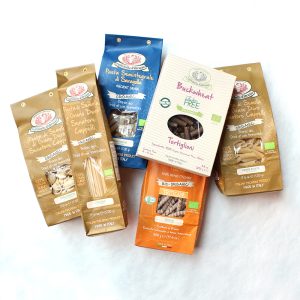
Pasta is the quintessential Italian food, and Italians eat it in enormous quantities. Add in the fact that you’re making exceptionally good, notably-more-flavorful-than-the-stuff-in-the-supermarket, artisan pasta, like the much-loved-at-Zingerman’s Rustichella brand (“the one in the brown bag”)… and it seems like as straightforward a recipe for success as one could possibly script.

But 1924 — the year that Gianluigi Peduzzi’s grandfather, Gaetano Sergiacomo, got going in the pasta business — might have been one of the worst times in Italian history to start making pasta — maybe akin to opening a bank in 2008. Of course, history gives us 20-20 hindsight. But take a look back at some of the stuff that Gianluigi’s grandfather would likely have been talking over with his friends and relatives when he got home from work, all covered with flour, sweaty from making spaghetti in the hot Abruzzese heat, and — if his start-up experience was anything like all the ones I’ve been through — emotionally exhausted.

For openers, the economy in Italy in 1924, while not the worst the world has ever seen, pretty much sucked. More specific to Gaetano’s work, the wheat crop in 1924 was not good, and prices were going up and up, making commercially produced pasta difficult for the average Abruzzese to afford. Most people weren’t even used to going out to buy pasta back then.

While the pasta in places like Naples and Genoa — the capitals of commercial pasta making in Italy for many centuries — was much more commonly made by artisans and sold in shops or delivered to wealthier homes, in much of the country (like the Abruzzo), what most people were eating was still primarily homemade. Back in 1924, Gianluigi explained, “this pasta like my grandfather made was a luxury product and was mainly purchased and consumed on Sundays or during the holy days.” It was called pasta comprata (purchased pasta) to distinguish it from the pasta that people made every day at home.

And the raw materials apparently often weren’t all that great either. “The wheat,” Gianluigi told me, “was terrible. Only soft wheat.” This wasn’t really a new problem: the history of Italian pasta making shows a steady back and forth between people who could get the higher-quality, harder durum wheat, and those who were working the lower end of the quality scale. Many pastai at that time offered different grades of pasta, the best made with 100 percent pure durum semolina, gradually going down in quality and cost as more and more soft wheat was blended in.

The strange stylings of Italian politics compounded the problems. The majority of the top-grade grain used to make Italian pasta was imported, and Mussolini was adamant about reducing that amount. With less high-end grain to be had for pasta making, costs rose and quality fell — not good news for a quality-oriented pasta maker. Eating patriotically meant shifting one’s diet to polenta and rice. In 1928, the Fascist regime pushed its agenda even further by creating a National Rice Board and instituting National Rice Day. “Ricemobiles” were sent out all over the country to hand out free rice to homemakers to get them to put away the pasta and ring in a new, rice-based era of Italian culinary and economic independence.

One seeming upside might have been that the American appetite for pasta in the first decades of the twentieth century was on the increase, and the population of Italian immigrants here was ever more substantial — a new businessman might reasonably have dreamed about the potential of a big export market. Unfortunately, the closing of the shipping lanes during WWI, high wheat prices in Italy after the war and Mussolini’s Battle for Grain meant that high hopes for exports never panned out. In fact U.S. imports of pasta from Italy dropped drastically, sinking from 78,000 tons in 1913 to about a sixth of that level in 1928.

Pasta Past

Throughout, pasta remained pretty much a local product. Every town had its pasta factory, or maybe more than one; what we now call Rustichella was just one of the small pasta producers in the Abruzzo. “Until 1981,” Gianluigi told me, “almost 100 percent of our pasta was sold at the market in the town of Penne. The production was Monday to Friday, and the market was Saturday. The customers would come to the market at six in the morning, give the order and then come back to get the box at the end to go home.” Pasta at that time, by the way, was still pretty much all sold in bulk. As Gianluigi explained, “During that period pasta was sold loose and packed only at the moment of the purchase. The quality of the product was visible according to the color of the wrapping that was red or blue.” The sort of one-pound (or one-kilo) package we’re now so familiar with came to the U.S. only in the 1920s, and in most of Italy remained little known until our own era. “Gaetano Sergiacomo,” Gianluigi elaborated, “made our first paper bag, and still today this package characterizes our products, together with the brass studs.”

It’s worth noting that while the shapes of the pasta back in Gaetano’s era were pretty much what we’re familiar with today, the pasta itself probably didn’t taste exactly like what we’re used to. As Gianluigi said, most of the wheat available in the Abruzzo at the time wasn’t all that great. Even if the flavor of the grain itself was good, it can’t have been very consistent in the all-important-to-the-pasta-maker protein levels or gluten content. And while inconsistency probably wasn’t all that big of a deal when you were making pasta on the kitchen counter at home, it’s not conducive to making something special on a wider commercial scale.

It’s also important to understand that the times were changing in terms of technology. These days, the fact that small producers like Rustichella, Martelli and Cavalieri take upwards of two days to dry their pasta in machines made to work at fairly low temperatures is considered a marvel of modern-day artisan dedication. Their commercial competitors like Barilla and DeCecco do the drying in a matter of hours, yielding a pasta that’s basically “baked” and hence is brittle and breaks up during the cooking rather than retaining the chewy al dente texture that Gaetano would have liked.

A hundred years ago, though, two days wouldn’t even have been enough to get the work started — drying then took anywhere from two weeks to over a month! Done with only the sun and ambient air, the drying process took place in big open buildings, where racks (for shorter shapes like maccherone and penne) or carts with pasta hanging on poles (for long cuts like fettuccine, spaghetti and linguine) were left to set, and the moisture in the dough gradually evaporated. Under the right conditions, the racks were placed in the open air. Older Italian pasta makers still tell stories of how they had to watch the pasta to protect it from goats, dogs and other “predators.”

Three Steps to Good Drying
Back in that era, before computers or commercial machines had mechanized the process, drying was a difficult craft to master, akin to the skillful sensory work done by prosciutto makers, who adjust airflow as the temperature, wind and humidity change in order to achieve the ultimate in flavor through traditional curing. The same was true of drying pasta. The three stages of the pasta drying were:

1. Incartamento: This is when the drying created a natural crust on the outside of the still-soft pasta. Traditionally, this was done by putting racks of fresh pasta out into direct sunlight.

2. Rinvenimento: This second stage allowed the pasta to “recover” from its initial experience in the sun. The drying racks were put into a room that was about forty degrees cooler than during the incartamento. Pasta at this stage was stored as close to the floor as possible, or, alternatively, in cool cellars, where the lower temperature and higher humidity slightly softened
its crust.

3. Essiccazione definitiva: This “final drying” stage was usually done in shaded areas, often courtyards or attics, where the pasta was gradually dried most of the rest of the way through. For long pastas like linguine, this was particularly challenging — the pasta had to be shifted between warmer and cooler temperatures to get the drying just right. As with ham curing, the process could be managed by moving the pasta from one room to the next, or by opening or closing windows to catch the proper breezes.

You can see pretty quickly why dried pasta was a luxury item. At best, in settings where the climate was close to ideal, the necessary temperature swings could be obtained by simply sticking with the natural atmospheric changes over a period of a week or more. Drying in the winter, even in the South, took two to three times as long as it did in the summer, or in many areas couldn’t be done at all. Pasta that was to be shipped abroad was dried longer than that which was sold for local consumption in the reasonable belief that it needed to hold up longer.

With all that old-time drying in mind, imagine the pressure on production systems when — in the second half of the nineteenth and early part of the twentieth centuries — machinery was introduced that significantly speeded up the mixing and then the extrusion of the pasta through metal dies. While pasta could be made much more quickly, there was no way to dry it any faster, which made for huge backlogs in the system. Not surprisingly, then, the development of modern drying machinery soon followed. When Gianluigi’s grandfather got going, drying was still done completely by feel; today the Peduzzis work with a carefully calibrated pasta moisture analyzer to target a residual “humidity” level of 12 percent. If the moisture is left higher, the spaghetti will spoil; if it’s over-dried, the pasta won’t properly ferment, and its flavor will be off.

The Advent of Al Dente
A few hundred years ago, most Italians were eating pasta that had been cooked ten to twenty times longer than I would ever dream of today. The trend to al dente originates in the South (as in Naples, not North Carolina). The tradition there positioned pasta as a street food — people bought just-cooked, steaming-hot spaghetti pulled from pots of boiling water by vendors, sprinkled it with grated cheese, then wound it around their fingers and put it straight into their bocca (mouth). In that context, al dente makes sense — you’d need spaghetti strands that didn’t turn to mush. Northerners, by contrast, generally ate their pasta only after much longer cooking — cooked ten to twenty times longer than I would ever dream of today — often to the point of making it into what Neapolitans would consider a veritable mush.

While far less extreme than in, say, 1800, that regional difference is still strong. On my visit this past summer, Rolando Beremendi, the long-time American importer of Rustichella, lamented one night at dinner how hard it is, even in restaurants in Italy, to find properly cooked — very al dente — pasta. “Really?” I asked, surprised. “It’s terrible,” he said, shaking his head. “I like it cooked for just seven minutes, with a little ‘crack’ in the middle still. But in Florence [where he lives], they kill dry pasta. And in Bologna! God forbid you should order dry pasta! They are only used to fresh pasta, so they don’t know how to cook pasta secche properly!”

Keys to Pasta Quality
For openers, there’s the extrusion. While the basic process of mechanically pushing the dough through thick bronze dies dates to the late nineteenth century, most big producers today have long since left the bronze behind and bought the easier to use, longer-lasting Teflon. Not so for Rustichella (or Martelli for that matter). “The bronze dies,” I put down on my legal pad in November of ’92, “are one of the keys.” By contrast, I continued, “big producers use Teflon. Bronze dies not only cost more, they must be replaced a lot more often. They’re softer and hence break down more quickly — bronze dies for the big selling cuts have to be replaced annually. For the other cuts, it’s every two to five years. They cost about $1000 each, and you have to have a different die for each cut.”

Gianluigi is equally dedicated to bronze extrusion today. The dies really do make a huge difference in quality — the surface of the pasta is much rougher, which means that it cooks better and, as it’s meant to do, absorbs a bit of the sauce, instead of having the slick, Teflonic surface of industrial pasta, leaving the sauce to run off quickly to pool at the bottom of your bowl.

Given today’s much higher volume for Rustichella, and the price of pretty much everything going up as it does, the replacement cost and frequency must both be far higher than they were in the week following Clinton’s election. One thing that has changed is that the Peduzzis have put much more technology into play. Happily, it’s all been in service of product quality, not the usual effort companies make to cut corners and production costs as they grow. The dies, I learned this time, can expand slightly from the heat as the dough is pushed through them — these days a machine reads the microscopic changes and adjusts accordingly.

The second key point, is the quality of the grain. While most folks think of pasta as being made from flour, every producer I’ve met over the years quickly corrects me if I forget and says, usually with great gravity, “grano.” Law #580, passed in 1967, required that all Italian producers use only durum semolina, and Rustichella has used 100 percent durum semolina for most of the last century. But there are big differences between great grain and the so-so stuff that mass-market makers rely on. Gianluigi told me that Rustichella was using wheat from the Abruzzo and the neighboring Molise whenever possible. Interesting, thinking back to Mussolini’s Battle for Grain, and a good preface to this year’s introduction of PrimoGrano pasta, but more on that in a minute.

Drying is the third big factor. Rustichella takes two days for the long cuts, one and a half days for short cuts at 30°C. Commercial producers dry long cuts in seven hours, short cuts in three to four. Today Rustichella uses computers to check the residual moisture inside the pasta, but the basic process is still those centuries-old three steps to good drying — with the same results. While most people assume that pasta is just flour — whoops, grain — and water mixed, shaped and dried, one of the keys to flavor is that well-made pasta is actually a fermented product. Longer, gentle drying allows for more effective, slower fermentation, which, just as with cheese making, bread baking or converting wine to vinegar, means fuller flavor. You can’t see it on the box, but you can definitely taste the difference.

For great flavor and texture the newly dried pasta must be allowed to cool slowly. Rustichella lets the temperature come down gradually — from the low drying temperature of about 90°F to room temperature over a period of twelve hours or so. “In industry,” Gianluigi explained, “it comes out at 95°C [over 200°F]. And then they must chill it quickly in a cooler before packaging. It won’t work otherwise.” The result is, again, a brittle and not very flavorful pasta. A 1987 Italian study found that high-temperature drying also destroys most of the grain’s natural nutritional value. Sample some al dente Rustichella fettuccine, and you’ll never go back to the supermarket stuff, no matter how well known and less costly the mass-market brands might be.

The difference between artisan pasta like Rustichella (or Martelli) and the mass-market stuff comes out big time when you cook it. The slightly chewy texture, wheaty aroma and full flavor of well-made artisan pasta reminds me of what classic Italian cooks have always known — the point of a pasta dish is the pasta itself, not the sauce. Interestingly, good pasta’s flavor actually improves with time! “If you taste now after ten minutes,” Gianluigi said, pointing to two bowls of pasta that we’d tried hot a bit earlier, “the taste of our product tastes like good bread. The DeCecco,” he added, “will taste like flour.”

I’ve tried this at home a few times and been amazed by how accurate he was. While I’d never thought of enjoying cold leftover pasta, Gianluigi is right on — a day or two after being cooked and cooled, Rustichella, brought back to room temperature, actually tastes terrific. I would guess that Gaetano got that one right from the get go.

PrimoGrano!: Great Pasta Comes Full Circle
All of which brings me to PrimoGrano, the new, limited-edition pasta that Gianluigi is making. The name means “First Grain,” and fittingly, the initial shipment just arrived in Ann Arbor around Christmas. I’m honored that we get to be one of the only places in the U.S. to get some. A timely gift from the Peduzzi family for long-time pasta lovers (like me), the PrimoGrano has a flavor that’s very special, sort of luxurious, but in an understated, modest sort of way. It’s now a regular on my list of favorite pastas.

Having eaten it regularly for the last few months (it’s true — I got the sample bags before you could buy it), I will say that I really like this stuff, both for the pasta itself (pretty terrifically tasty) and for the project overall. The latter is really representative of most of the things I think go into making a special business ever more special. It’s really no small thing. You have someone who’s achieved a great degree of success, whose product is sold all over the world, is known for being among the best around. But instead of standing pat, Gianluigi has invested enormous amounts of energy, time and I’m sure money to make something special happen.

“We start to make the pasta in 2004 for the eightieth anniversary of the company,” he told me this summer. “We worked with the University of Foggia in Puglia [a few hours south of his hometown of Pianella], and we started to study the new variety of grain. We finished this variety — what we call ‘San Carlo’ — in 2002. The yield is lower, but the flavor is very good. We did the first experiment for 2003 to grow three hectares. Just to make a small amount to taste for the eightieth anniversary.”

And now, the PrimoGrano is ready for you and me to eat regularly.

“I wanted to make a product the way it was in 1924,” he told me and as he talked, I realized that while he wanted to re-create the pasta of his grandfather’s era, in fact, he was driven — respectfully — to make something even better.

“In 1928,” he continues, “there was this pasta made by my grandfather, with 100 percent Abruzzo wheat. But back then it was made without very good technology. When you cooked it, the taste was good, but the texture wasn’t as good as what we have today.”

Modern technology has actually helped make the pasta better than it was back when Gaetano got going. “With San Carlo,” Gianluigi explained, “we can make the pasta again with 100 percent Abruzzo wheat. San Carlo is 80 percent, but we also blend the Varano, Quadrato and Mongibello varieties. And now we have the techniques of today so that the taste is like it was then but the texture is much better.”

While the PrimoGrano project was triggered by Rustichella’s eightieth anniversary, this isn’t about doing a one-off pasta for PR purposes. To the contrary, it’s all very holistic and long term — the idea is to get the San Carlo grounded in local agriculture, then build enough demand for the pasta to keep it going. And in the process provide consumers with a great-tasting product and farmers with something special to grow. “I wanted to work with the farmer,” Gianluigi said. “It was the same area of the province that my grandfather bought the grain in the past. Many farmers would deliver the grain to his factory. And instead of the money he gave them the pasta.” I’m sure the farmers today get plenty of pasta as well, but Rustichella is actually paying more per kilo to keep them growing this special wheat: “We pay to the farmers 10 to 15 percent more for the San Carlo than for the normal market of the grain. Plus, we pay one Euro for the farmer to cultivate only this variety. And two Euros for every percentage protein over 16 percent. So about 20 percent more.”

All the other good stuff then goes into play. The milling is done at Rustichella’s usual spot, one of the smallest mills in Italy now, which specializes in custom work like this. The dough is extruded through the bronze dies, and then dried very slowly (by modern standards — they still haven’t gone back to sun drying!). The pasta actually cooks up fairly quickly — Gianluigi says this is because the Abruzzo wheat is a bit lower in protein than the imported wheats that are blended into their other pastas. The flavor is wheaty, delicate and really pretty delicious.

Elizabeth Minchilli, a food writer who grew up in St Louis and has lived in Rome for over twenty-five years now, loves it. Given where she lives (in the middle of Rome) and what she does (food writing — the woman can get pretty much any pasta she wants and has probably tried most everything at some point or another), that’s no small compliment. “I really liked the taste of the pasta. It didn’t seem so neutral like most pasta, but had a distinctive, sort of nutty/wheaty taste to it. Also it was chewier, and more resistant, and had a better texture.” I’d agree.

We’ve got the PrimoGrano in three shapes. Chitarra are the traditional square-shaped long pasta of the Abruzzo. Penne, bearing the same name as the village where Gaetano got the pastificio going back in the ’20s, are quill shaped. And finally, the squiggly-edged, really cool-looking Sagne a Pezzi. All definitely have that nutty delicate deliciousness. To bring out the best of the wheatiness, I’ve been dressing it lightly — just fruity green olive oil and grated cheese; sautéed zucchini and bits of fried pancetta; white beans, fresh rosemary, a touch of well-sautéed celery and a generous dose of good olive oil.

Host Your Own Chocolate Tasting

Monday, March 22nd, 2010 by Zingerman's Deli

March 2010

As promised, this month’s newsletter is all about hosting a chocolate tasting. It isn’t step-by-step per se (that would be too long!) but it is more a list of helpful hints that I’ve gathered over the past few years. I counted the other day and figured out that I’ve done 96 tastings (!) most of them at the Deli, but some of them out in the community at libraries, schools, etc. I’ve also had the good fortune to be an audience member for a number of presentations given by experts in the field. From all this I’ve learned a bit about what works and what doesn’t, as well as how to best prepare.

THE most important thing is this: There is no certificate or diploma that you need to have to host a tasting — I encourage you to just jump in and give it a try. Get organized, get your hands on some great chocolate, invite some fun, outgoing people over, and just do it! The worst thing that could happen is that you have a chaotic chocolate-eating extravaganza. The best thing that could happen is that you have a fun, thoughtful tasting/discussing with your friends and everyone learns something new about chocolate. Both scenarios are somewhat appealing, non?

As always, I am only an email (duffatzingermansdotcom  (duffatzingermansdotcom)  ) or a phone call (734-663-5282) away if you have any questions or comments for me. Have fun tasting!

Duff


duffatzingermansdotcom  (duffatzingermansdotcom)  
734-663-5282

· A couple weeks before your tasting ·

Decide on your tasting theme
The first thing to decide is whether you want to taste chocolates from several different companies or just stick to one brand. If you are just starting out and really trying to get to know the major brands out there, I suggest tasting them one at a time. Cluizel, Pralus, Askinosie, Bonnat… you won’t be able to taste an entire product line (you’ll want to limit the tasting menu to about 6 chocolates), but you will get a really good feel for the style/quality of each brand if you taste through them methodically.

If you want to sample a wider selection of chocolates, then settle on a theme (%, cacao origin, company origin, etc.) and gather chocolate bars from different brands to taste and compare. Chocolates in the 70-75% range, milk chocolate, chocolate from Madagascar, American bean-to-bar chocolates… the possibilities are endless!

Start gathering your chocolate!
Once you decide on a theme for your tasting, start building your tasting list. How many different chocolates will you taste? What chocolates do you want to compare? Where can you buy the chocolates you need (i.e. online, at Zingerman’s, etc.)? Usually a bar of each chocolate is sufficient for a group of 6-8 people, but I always have an extra one ready — just in case.

I strongly suggest including a “comparative” chocolate in your tasting line-up, mostly to serve as a reminder of the huge difference between mass-market sweets and fine chocolate. It’s the baseline from which most of us are starting and the “memory” chocolate that is burned into most of our olfactory databases. Tasting Dove, Hershey’s “Special Dark” or another well-known chocolate at the beginning and the end of the event is very, very illustrative, no matter what your theme is.

Send out some invites!

You want to try to taste chocolate when you are a little bit hungry, preferably not after a meal. Try for a mid-morning or late-afternoon gathering, 11-noon or 3-4 PM. An hour-long event should be plenty in the beginning. Establish some friendly guidelines to set your guests up for olfactory and gustatory success, like asking folks to refrain from drinking/eating strong things like coffee/garlic/mint before coming over (including toothpaste!) and from wearing perfume/cologne/scented chap stick/corsages (it could happen!) etc.

Start doing your (fun) homework
Learn as much as you can about the chocolates you will sample at the event. This usually starts with the company: What do you know about the people who make the chocolate? Do they actually make their own chocolate, bean-to-bar? If so, how long have they been making chocolate? What are their quirks? Do they favor certain processing techniques (ex. dark-roasting cacao beans)? Are they good at everything, or are they just famous for a couple of things? Start out by checking out company website and/or promotional materials — heck, you can even try calling the company and asking some questions. Some companies are kind of secretive so you can also ask your friendly local chocolate lady (moi) for info if you get stumped.

There are some good resources out there on the subject of evaluating chocolate and tasting thoughtfully. Some chocolate makers provide information/guidance on their websites, and there are some good books, too:

Maricel Presilla The New Taste of Chocolate
Chloé Doutre-Roussel The Chocolate Connoisseur. Chapter 4 is all about tasting. These are 25 pages that I have read over and over — especially when I first started my job at the Deli! You can find some of the content of this chapter on Chloé’s website here: http://www.chloechocolat.com/pdf/tasting.pdf
Dina Cheney Tasting Club (paperback comes out next month!)

· One week before your tasting ·

Taste the chocolates yourself

It is important to taste the chocolate/candies yourself before you host the event. This gives you the chance to take some notes and evaluate on your own time. Go through the steps (know, look, smell, touch, taste, etc.) and take some notes on each bar. Try to taste a few times, maybe even on consecutive days, to fully experience the chocolates. I know, it is a hard job :)
Make your materials list
Some supplies you might need for your tasting include:

  • Big post-it notes to stick up on the wall
  • Plain bread/unsalted crackers
  • Water (room-temperature)
  • Chocolate!
  • Pens/pencils
  • Prizes — Have fun! Stickers, t-shirts, your favorite chocolate recipe on a recipe card, etc.
  • Paper to take notes on, or maybe little notebooks for everyone!
  • Vocabulary sheet/visual aid — I find it is helpful to provide folks with a copy of a tasting wheel. You can create your own or find one online. A couple that I like:
    - Vosges
    - Amano
  • A chocolate “Placemat” at each seat, with numbered or lettered squares to organize the chocolates.
  • A tasting list
  • Anything else you think will be relevant and helpful to your guests!

As you prepare, worry about protocol but only insofar as it will help people feel comfortable and ready to taste. For example, don’t stress about color coordinating your handouts and writing everyone’s name in calligraphy before they arrive, but do make sure you have water and bread.

· Day of your tasting ·

Prepare the room — remember: no flowers, room spray, potpourri, etc. Optimize your senses! Gather your materials and get as much done in advance as possible, just like you would for a dinner party. Make sure you eat something (real food) before the tasting, too otherwise you will feel funny. Believe me I know.

· Tasting time! ·

Relax everyone! Remember this is fun! As Presilla notes, the goal of a tasting is to help us to hone our senses and form opinions “without turning the act of enjoying chocolate into a pretentious ritual.” There is a very fine line between having fun tasting chocolate and having no fun at all because you are terrified you aren’t doing it right. Make your guests feel welcome and at ease, assure folks that there aren’t any right answers, that the only taste that counts is their own, not to worry about using the “right ” words, etc.

It is fun to start the tasting by asking, “On a scale of 0-10 (“0″ being you’ve never eaten chocolate in your life and “10″ being you’ve written a book on the subject), how confident do you feel about tasting chocolate?” You could pick another question, depending on the specific content of your tasting. Have everyone write their score down and share it with the group, then ask the same question at the end. Hopefully, it will go up not down!

Set some goals for the tasting and share them with your guests. By the end of the event, what will people be able to do that they couldn’t do before? What will they learn over the course of the hour? Everyone likes to look back and the end and feel like they’ve made progress.

Introduce each chocolate before you taste it. You can do this by telling a mini “story” about the brand or by having one of your guests read the label of the bar aloud. Gathering stats together as a group like this is a nice way to get people to talk and do things “live.”

When you start to evaluate the chocolate (looking for the characteristics we talked about in January’s newsletter!) encourage your guests to think critically. This is where the difference between eating chocolate and tasting chocolate becomes apparent. Ask the group questions to jog the discussion. Sometimes it is helpful to give people either/or and yes/no scenarios to think about: “Would you describe this bite as velvety or silty” “If you had to use one word to describe this chocolate to a friend, what would you pick?” “Does this chocolate make your mouth water or make it dry?”

Ask for feedback, especially if you plan on doing this more than once. The most important question you can ask is: “How much fun did you have?” Because — in the end — that’s what it is all about.

Ravishing Raspberry Vinaigrette

Friday, March 12th, 2010 by Jaime
Ingredients:

  • 1/2 cup Jaeger Family olive oil
  • 1/2 cup 6yr Balsamic vinegar
  • 2 tbsp American Spoon Raspberry Preserves
  • Salt & pepper to taste

jamie_sig

Directions:

  • I love to mix my vinaigrettes in a sealable plastic container so all that I have to do is add the ingredients, seal it up, and shake away!
  • To obtain a really smooth mixture, combine the vinegar and preserves first & shake. Next add the olive oil & shake. Season with salt & black pepper to your liking.
  • Makes 1 cup

Montgomery’s Cheddar- her favorite of the week

Friday, March 12th, 2010 by Claire

Neal’s Yard Dairy cheese!

Tuesday, March 2nd, 2010 by Vanessa

Zingerman’s Gelato Tasting – SOLD OUT!

Monday, March 1st, 2010 by Zingerman's Deli
Thursday, April 22nd, 7-9 PM UPND

There are few things in the world as delicious as Zingerman’s gelato. Even to those of us who work with it everyday, tasting a sweet, creamy spoonful always feels like a luxury! There are a lot of reasons why our gelato is so special — the milk we use, the recipes we develop, and the person who makes each and every batch: our expert gelatier, Josh Minor. Join Josh and Deli Gelato Maiden Emily Hiber for spoonful after spoonful of this wonderful stuff. You’ll taste no-less-than seven different gelati, do a comparative tasting, and learn all about ice cream’s Italian cousin. It’s a harbinger of spring!

SOLD OUT!

Let Them Eat Cake!

Monday, March 1st, 2010 by Zingerman's Deli
Tuesday, April 13th, 7-9 PM

Zingerman’s Bakehouse cakes are as fun to eat as they are to look at! From frosting to crumb, they are packed with great ingredients like farm-fresh eggs, real butter, dark chocolate, toasted nuts, Italian preserves and real vanilla bean. We will sample and discuss no less than seven Bakehouse cakes, including the Hunka Burning Love Chocolate Cake, the perfectly spiced 24-Carrot Cake, the ultra dense and creamy Cheesecake, our famous Sour Cream Coffee Cake . . . and more! Zingerman’s Bakehouse Partner and baker extraordinaire Amy Emberling will talk about the different categories of cake, lead us in a comparative tasting, and share some expert tips for baking at home. So settle in (with a glass of milk, of course) for the dessert tasting of your dreams!

$30/in advance and $35/at the door, Call 734-663-3400 to save a seat!

2nd Annual Family Spaghetti and Meatball Night

Monday, March 1st, 2010 by Zingerman's Deli
Wednesday, April 7th, 4-7 PM

What better way to bid adieu to winter than with a perfect plate of spaghetti and meatballs? We’re making housemade meatballs and sauce from Goetz Farm tomatoes for the occasion and serving them up with great pasta, a generous sprinkling of Parmesan cheese, and a slice of Bakehouse bread. We’ll have activities for kids upstairs in Zingerman’s Next Door to keep the little ones occupied between bites. No reservations required – just place your order in the Deli, fetch your pasta, sit wherever you like – and dig in!

Kid portion $5.99/ea, Adult $9.99/ea, available at the Deli!

St. Patrick’s Day Corned Beef and Cabbage

Monday, March 1st, 2010 by Zingerman's Deli
Wednesday, March 17th, 11-7 PM

You don’t have to love bagpipes or the color green to get in on this St. Patrick’s Day celebration – you just have to love great food! We’re serving up a hearty plate of traditional Irish fare – hand-sliced Zingerman’s Corned Beef (with a side of our extraordinary hot mustard), steamed potatoes, carrots and cabbage, and a wedge of Zingerman’s Bakehouse Irish Soda Bread with farm butter. No reservations needed! Just order in the Deli and dine with us or let us pack you a plate to go.

$14.99/plate, available at the Deli!

70% Chocolate Rendez-Vous

Monday, March 1st, 2010 by Zingerman's Deli
Thursday, March 11th, 7-8PM

There are a lot of dark chocolate bars out there hovering in the magical 70% range and they all taste different. Some are fresh and mild, and others are wild and tannic! Raspberries, olives, coffee, bananas… what will you taste? Come and find out! We’ll sample several different dark chocolate bars from around the world, illustrating how — in the grand scheme of things — % is just a tiny piece of the flavor puzzle.

$20/in advance and $25/at the door, Call 734-663-3400 to save a seat!